Wall-mount or deck-mount? It's the first fork in the road when choosing a bathroom faucet, and it's a decision you make once — because switching later means opening a wall or drilling a countertop. The good news: the right answer is usually obvious once you know what each mounting style demands from your plumbing, your sink, and your cleaning routine.
This guide walks through how each type installs, what it costs, where each shines, and the handful of situations where one is clearly the better call. If you're also weighing handle configurations, our companion guide on single-handle vs widespread faucets pairs naturally with this one.
The Basic Difference
A deck-mounted faucet installs on a horizontal surface — the sink deck or the countertop behind it. Water lines run up through the vanity cabinet, and the faucet body sits in one to three pre-drilled holes. This is the standard configuration in the vast majority of American bathrooms.
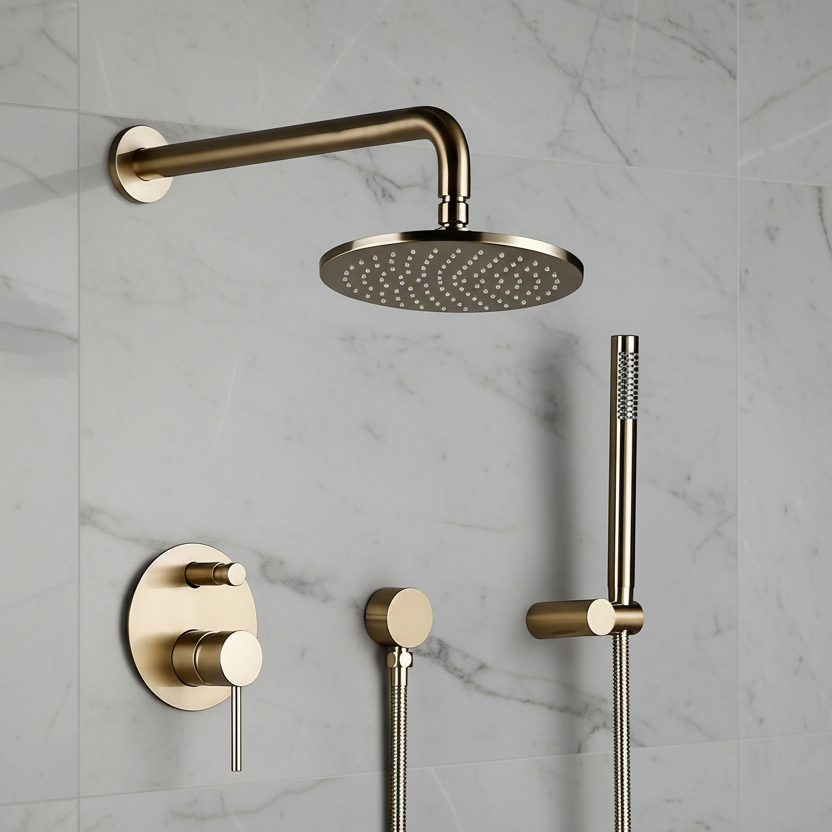
A wall-mounted faucet installs on the wall above the sink, with the spout reaching out over the basin. The valve and supply lines live inside the wall, so nothing touches the counter at all.
Side-by-Side Comparison
| Factor | Deck-Mount | Wall-Mount |
|---|---|---|
| Installation | Drops into sink/counter holes; DIY-friendly | In-wall valve; plan during a remodel |
| Plumbing location | Under the vanity | Inside the wall |
| Counter space | Occupies deck area behind sink | Frees the entire counter |
| Cleaning | Grime collects around the base | Wipe the counter in one pass |
| Sink pairing | Standard drop-in & undermount sinks | Vessel sinks, trough sinks, floating vanities |
| Relative install cost | $ | $$–$$$ (wall access required) |
| Repair access | Easy — everything is reachable | Valve access through trim or wall |
| Design effect | Classic, familiar | Architectural, minimalist |
Where Deck-Mount Wins
Deck-mounting is the pragmatic choice. Installation is a straightforward afternoon job on any standard sink, replacement is just as easy, and every part of the faucet is reachable if a cartridge ever needs service. If your sink or counter already has faucet holes — which nearly all do — a deck-mount faucet uses them without any construction.
It's also the budget-friendly path: no wall opening, no in-wall rough valve, no tile repair. For rentals, guest baths, and quick vanity refreshes, deck-mount is almost always the right answer. Browse our full bathroom faucet collection — most widespread and single-handle designs there are deck-mounted.
Where Wall-Mount Wins
Wall-mounting is the design choice. With the faucet up and off the counter, the sink area reads dramatically cleaner — there's no base to clean around, no water pooling at the escutcheon, and the counter wipes down in one motion. It's the natural pairing for vessel sinks, where a deck faucet often can't clear the rim, and for floating vanities and trough sinks where minimalism is the point.
Height is also adjustable at installation: because you set where the spout exits the wall, you control clearance over the basin precisely — something fixed deck faucets can't offer.
The Honest Trade-Offs
Which Should You Choose?
Frequently Asked Questions
Can I convert my deck-mount faucet to wall-mount?
Yes, but it's a plumbing project, not a swap — supply lines must be rerouted into the wall and a rough-in valve installed, then the wall refinished. It's best bundled into a remodel rather than done standalone.
Do wall-mounted faucets drip inside the wall?
A properly installed rough-in valve is sealed and pressure-tested before the wall closes. Quality solid brass valves with ceramic cartridges — the standard across our wall-mount range — are designed for decades of in-wall service.
Are wall-mounted faucets harder to repair?
Cartridge replacement happens through the trim plate without opening the wall. It's slightly less convenient than a deck faucet, but routine service doesn't require construction.
What finish works best for a wall-mounted faucet?
Because the faucet reads as part of the wall, high-contrast finishes make the strongest statement — matte black against light tile, or brushed gold against deep tones. See our guide to brushed vs polished gold for choosing the right tone.