Every shower system sold today uses one of two valve technologies to protect you from sudden temperature swings: pressure balance or thermostatic. Both stop the classic scalding-shower scenario — someone flushes a toilet, the cold supply drops, and the water turns burning hot. But they solve the problem in very different ways, at very different price points, and the right choice depends on how you shower, who lives in your home, and what your plumbing looks like.
This guide breaks down how each valve works, where each one wins, and which we recommend for specific situations — so you can choose your next shower system with confidence.
What a Shower Valve Actually Does
Behind every shower handle sits a mixing valve. Its job is to blend hot water from your heater with cold water from the supply line and deliver the mix at the temperature you choose. The challenge is that household water pressure is never perfectly stable. Run the dishwasher, start a laundry cycle, or flush a toilet, and the pressure on one side of the mix changes instantly. Without a compensating mechanism, the blend shifts — and you feel it as a freezing or scalding surge.
Pressure balance and thermostatic valves are the two compensating mechanisms. Understanding the difference takes about two minutes, and it will make your entire shower purchase clearer.
How a Pressure Balance Valve Works
A pressure balance valve monitors the ratio of hot to cold water pressure. Inside the cartridge, a sliding piston or spool reacts to pressure changes in real time: if the cold supply suddenly drops, the piston moves to restrict the hot side proportionally, keeping the mix ratio — and therefore the temperature — roughly constant, typically within a few degrees.
Pressure balance valves use a single handle. Turning it controls temperature; water volume is essentially all-or-nothing. Most valves include an adjustable limit stop, set during installation, that caps how hot the water can get — a meaningful safety feature for households with children or older adults.
Strengths: simple, reliable, compact, and significantly less expensive to buy, install, and repair. There is a reason this is the most common valve in American homes.
Limitations: it holds a ratio, not a temperature. If your water heater output cools down mid-shower, the valve keeps the same blend and your shower gradually cools with it. You also can't run a gentle flow at full heat — volume and temperature are tied to one control.
How a Thermostatic Valve Works
A thermostatic valve measures the actual temperature of the mixed water. Inside the cartridge, a thermosensitive element — typically a wax compound that expands and contracts with heat — continuously adjusts the hot/cold blend to hold the exact temperature you set, usually to within one degree. If the incoming pressure or the hot-water temperature changes, the element compensates within a fraction of a second.
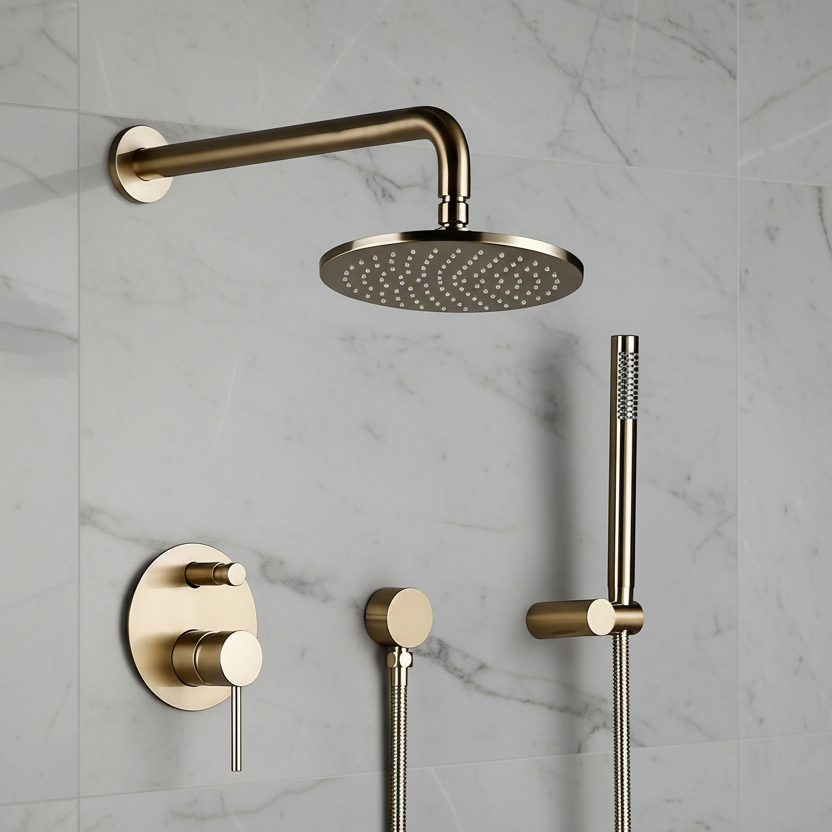
Thermostatic valves use two separate controls: one dial sets the temperature, the other controls flow volume. That separation is the luxury. You can set your preferred temperature once and it will be identical every day — and you can turn the flow down to a trickle while shaving without the temperature drifting. Most thermostatic valves also include an anti-scald safety stop at 100°F (38°C) that requires a deliberate override to exceed, plus an automatic shutoff if the cold supply fails completely.
Strengths: precise, repeatable temperature; independent volume control; the strongest scald protection available; the standard choice for luxury shower systems with multiple outlets like rainfall heads and handheld sprayers.
Limitations: cost — typically 1.5 to 2 times the price of a comparable pressure balance system — plus a slightly larger in-wall footprint and a thermostatic cartridge that can accumulate mineral scale in hard-water areas, which may require periodic cleaning or replacement.
Head-to-Head Comparison
| Factor | Pressure Balance | Thermostatic |
|---|---|---|
| What it controls | Hot/cold pressure ratio | Actual water temperature |
| Temperature accuracy | Within a few degrees | Within about one degree |
| Controls | One handle (temp + flow together) | Two controls (temp and flow separate) |
| Volume control | No — essentially full flow | Yes — independent of temperature |
| Scald protection | Adjustable limit stop | 38°C safety stop + auto shutoff |
| Multi-outlet showers | Limited | Excellent — built for them |
| Relative cost | $ | $$–$$$ |
| Hard-water sensitivity | Low | Moderate (cartridge descaling) |
Which Should You Choose?
Choose a pressure balance system if: you're outfitting a guest bath, a rental, a kids' bathroom, or any shower where simplicity and budget lead the decision. You get genuine anti-scald protection and dependable performance at the lowest cost, with cheaper cartridge replacements down the road.
Choose a thermostatic system if: this is your primary shower and you value a consistent, dialed-in experience; your household has significant pressure fluctuations (older plumbing, multiple simultaneous water users); you're installing a multi-outlet setup with a rainfall head and handheld sprayer; or maximum scald safety for children or elderly family members is a priority. For a deeper look at the safety side, see our guide to thermostatic shower safety features.
A practical middle path: many homeowners put a thermostatic system in the primary bath and pressure balance systems everywhere else. That concentrates the budget where it's felt daily.
Installation and Cost Notes
Both valve types install in the wall behind the trim, so replacing one type with the other involves opening the wall and is best planned during a remodel. Like-for-like cartridge replacements, by contrast, are simple maintenance. Thermostatic bodies are somewhat larger, which occasionally matters in tight retrofit cavities. In hard-water regions, plan on descaling a thermostatic cartridge every year or two to keep its response crisp — a ten-minute job with white vinegar.
Whichever you choose, insist on a solid brass valve body and ceramic disc internals. Those two materials determine whether a shower system lasts five years or twenty-five. Every system in our shower collection is built on both.
Frequently Asked Questions
Is a thermostatic shower valve worth the extra money?
For a daily-use primary shower, usually yes — the consistency and independent volume control are felt every single day. For secondary bathrooms, a quality pressure balance valve delivers the essential safety at a fraction of the price.
Can a pressure balance valve run multiple shower heads?
It can run a diverter setup where outlets take turns, but it lacks independent volume control, so running a rainfall head and handheld simultaneously works far better on a thermostatic system.
Do thermostatic valves work with tankless water heaters?
Yes, and the pairing is popular — the valve smooths out the temperature oscillations some tankless heaters produce. Confirm the heater's minimum flow rate is met when running the shower at low volume.
How do I know which valve type my current shower has?
Count the controls. One handle that you turn further for hotter water is almost always pressure balance. Two separate controls — one marked with temperatures or a 38°C button, one for flow — is thermostatic.
Ready to upgrade? Browse our complete shower systems — pressure balance and thermostatic designs in solid brass, in every finish from chrome to brushed gold.
New to shower systems? Start with our complete buyer's guide: How to Choose a Complete Shower System.