In an era of increasingly complex kitchen fixtures boasting touchless sensors, pull-down sprayers, and multi-function spray patterns, a counterintuitive trend is gaining momentum: the deliberate choice of single cold water kitchen faucets. This reductive approach eliminates the hot water supply entirely, creating a streamlined fixture that addresses specific use cases with remarkable efficiency. Whether you're outfitting a workshop sink, installing a secondary prep station, or designing a utility kitchen where simplicity trumps versatility, understanding the nuances of single cold water kitchen faucet installation unlocks both practical and aesthetic advantages.
The proposition seems almost antithetical to modern expectations. Yet for discerning homeowners, designers, and contractors who prioritize purposeful design over feature accumulation, these minimalist fixtures represent an intelligent solution to particular spatial and functional challenges. The installation process differs markedly from conventional dual-handle or single-lever mixing faucets, demanding specific knowledge about supply line configuration, mounting protocols, and code compliance considerations.
Understanding the Single Cold Water Paradigm
Single cold water faucets occupy a distinctive niche in the fixture taxonomy. Unlike their hot-and-cold counterparts that require balanced pressure from dual supply lines, these dedicated cold-water units simplify the hydraulic equation to its fundamental essence. The resulting apparatus typically features a solitary control mechanism—often a traditional compression valve or quarter-turn ceramic disc cartridge—that modulates flow from a single source.
This reductive architecture yields tangible benefits beyond mere simplicity. Installation timelines contract significantly when you're routing one supply line instead of two. Maintenance intervals extend because fewer internal components mean reduced failure vectors. The probability of scalding incidents evaporates entirely, making these fixtures particularly suitable for environments frequented by children or vulnerable populations.
Commercial kitchens, potting sheds, garage utility sinks, and outdoor kitchen stations represent prime deployment scenarios. In these contexts, hot water constitutes an unnecessary luxury or even a liability. A potter rinsing clay-caked hands benefits from cold water that doesn't prematurely dry the skin. A gardener washing vegetables harvested minutes earlier finds ambient-temperature water perfectly adequate. The elimination of hot water infrastructure removes both capital expenditure and ongoing energy consumption from the equation.
Evaluating Material Specifications for Longevity
Material selection separates ephemeral fixtures from heirloom-quality installations. Solid brass construction remains the gold standard, offering superior corrosion resistance and dimensional stability across decades of thermal cycling. Brass alloys containing 60-70% copper exhibit optimal ductility and machinability while maintaining structural integrity under pressure.
The finish applied to the base metal dramatically influences both aesthetics and durability. Physical vapor deposition (PVD) finishes demonstrate exceptional hardness and tarnish resistance compared to electroplated alternatives. Chrome, brushed nickel, oil-rubbed bronze, and matte black finishes each possess distinct maintenance requirements and patina development characteristics. Understanding these trajectories ensures alignment between material choice and long-term aesthetic expectations.
Internal valve components warrant equal scrutiny. Compression valves featuring replaceable rubber washers offer time-tested reliability and straightforward serviceability. Ceramic disc cartridges provide virtually drip-free closure and silky-smooth operation through hundreds of thousands of cycles. Quarter-turn ball valves occupy a middle ground, balancing ease of operation with robust construction.
Heritage Single Cold Water Kitchen Faucet: Purposeful Simplicity
When installation demands converge with aesthetic sensibilities, the Heritage Single Cold Water Kitchen Faucet from Allfixture exemplifies thoughtful engineering. Constructed from premium solid brass with a choice of contemporary or timeless finishes, this fixture addresses the specific challenges inherent in single-supply installations while maintaining visual coherence with broader kitchen design themes.
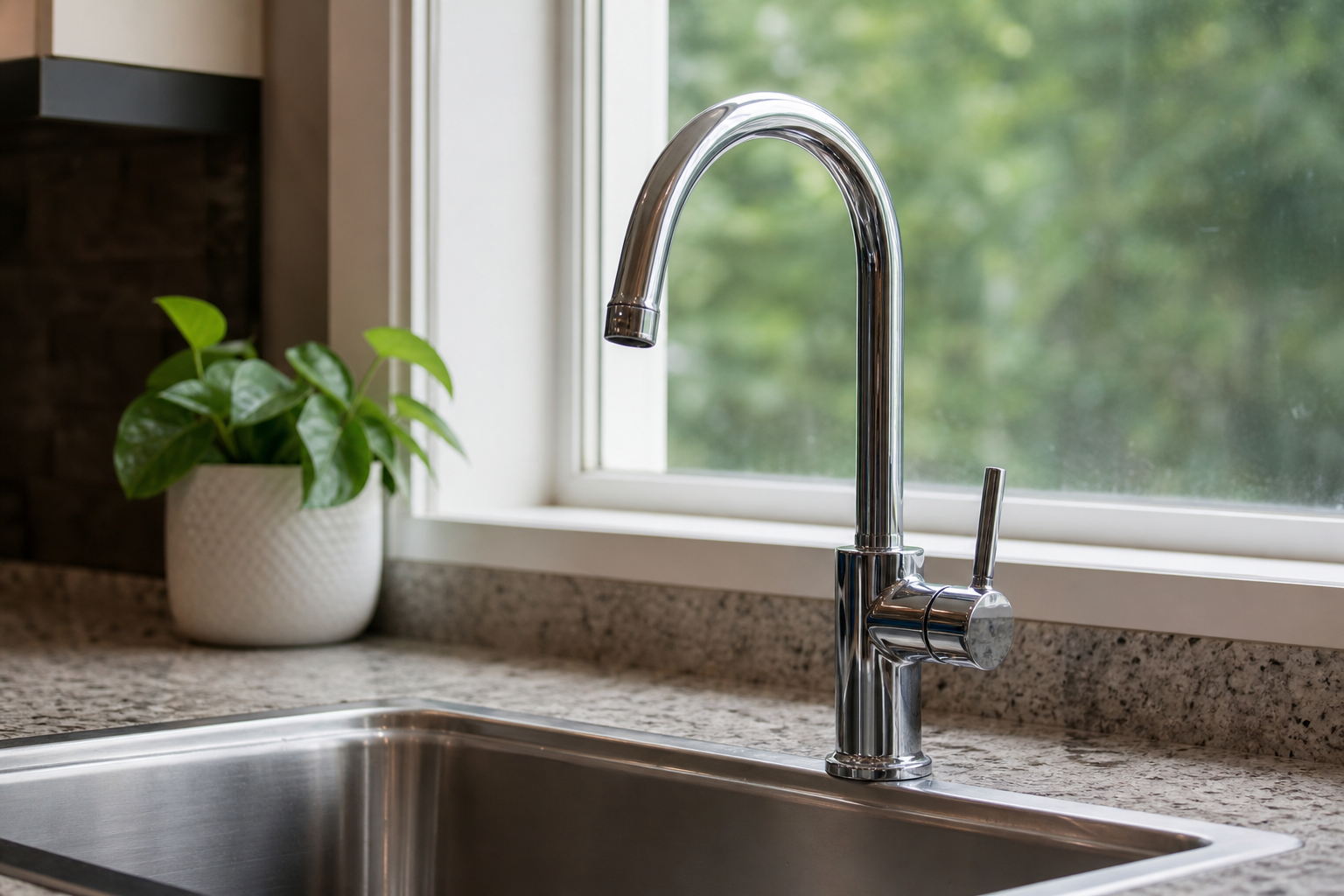
The Heritage model features a traditional gooseneck spout with a generous 8-inch reach, providing ample clearance for filling large vessels or cleaning oversized cookware. Its quarter-turn ceramic disc valve delivers precise flow control with minimal effort, while the solid brass construction ensures dimensional stability even under fluctuating water pressure. For contractors and designers seeking a fixture that balances utilitarian function with refined aesthetics, this unit represents a specification-worthy solution.
The fixture's standardized mounting footprint accommodates typical three-hole sink configurations, with optional deck plate coverage for single-hole installations. This adaptability proves invaluable when retrofitting existing countertop penetrations or integrating the faucet into new construction where substrate conditions remain fluid during the design phase.
Pre-Installation Assessment and Planning
Successful single cold water kitchen faucet installation begins long before tools contact plumbing. A methodical pre-installation assessment identifies potential complications while they remain theoretical rather than tangible obstacles. Begin by verifying the cold water supply line location relative to the intended mounting position. Standard under-sink plumbing typically includes both hot and cold shut-off valves; confirm which line corresponds to cold water by briefly opening each valve and testing temperature.
Measure the sink deck thickness and material composition. Stainless steel, solid surface, granite, and wood substrates each present distinct drilling and sealing requirements. Thicker materials may necessitate extended mounting shanks or supplemental hardware to achieve secure attachment. Verify that adequate clearance exists beneath the mounting surface for the faucet body, supply line connections, and necessary tool access during installation.
Check local plumbing codes regarding backflow prevention devices. Some jurisdictions mandate vacuum breakers or atmospheric backflow preventers on all fixture installations, regardless of configuration. These devices interrupt potential siphonage scenarios that could contaminate potable water supplies, and their inclusion may influence spatial requirements and connection sequencing.
Assembling Required Tools and Materials
Competent execution demands appropriate implements. Assemble an adjustable wrench, basin wrench (for confined under-sink access), screwdrivers in both Phillips and flat-head configurations, plumber's putty or silicone sealant, thread seal tape (PTFE), and a flexible supply line of appropriate length. Braided stainless steel supply lines offer superior burst resistance compared to polymer alternatives, though either specification proves adequate for typical residential pressures.
Select a supply line length that provides modest slack rather than taut routing. This accommodation allows for minor positional adjustments during installation and reduces stress concentrations at connection points. Standard lengths range from 12 to 20 inches; measure the actual distance from shut-off valve to anticipated faucet mounting location and add four inches for routing flexibility.
Step-by-Step Installation Protocol
With preparatory work complete, the physical installation proceeds through a logical sequence. Begin by shutting off the cold water supply at the under-sink valve, then open any existing faucet to relieve residual pressure in the line. This precautionary step prevents pressurized discharge when disconnecting supply lines, minimizing water damage and facilitating cleaner working conditions.
If replacing an existing faucet, disconnect the old unit by loosening the mounting nuts beneath the sink deck and detaching the supply line. Remove any residual plumber's putty or sealant from the mounting surface using a plastic scraper to avoid scratching the substrate. Clean the area thoroughly with denatured alcohol to ensure optimal adhesion for new sealant applications.
Mounting the Faucet Body
Thread the faucet tailpiece through the designated sink penetration, ensuring any rubber or fiber gaskets seat properly against the upper surface. Most contemporary fixtures include an integrated gasket that eliminates the need for plumber's putty, though traditional installations may require a rope of putty applied circumferentially around the base perimeter.
From beneath the sink, slide the friction washer and mounting nut onto the tailpiece threads. Hand-tighten the nut until the faucet body contacts the sink surface with uniform pressure around its entire perimeter. Use a basin wrench to apply an additional quarter-turn, compressing the gasket sufficiently to create a watertight seal without over-torquing, which can crack ceramic sinks or deform softer materials.
Verify that the faucet remains properly oriented relative to the sink basin. The spout should align centrally over the drain, with handle operation unobstructed by backsplashes or adjacent fixtures. Minor rotational adjustments at this stage prove far simpler than post-connection realignment.
Connecting the Supply Line
Wrap three to four layers of PTFE thread seal tape clockwise around the exposed threads of both the faucet tailpiece and the shut-off valve outlet. This directional application ensures the tape tightens rather than unravels during connection assembly. Attach one end of the flexible supply line to the faucet tailpiece, hand-tightening until resistance increases noticeably.
Connect the opposite end to the cold water shut-off valve using identical technique. Once both connections achieve hand-tight status, apply a wrench to each nut for an additional half-turn. Excessive torque can damage internal gaskets or crack valve bodies, while insufficient tightening invites seepage. The tactile feedback at this transition point develops with experience but generally occurs when resistance increases markedly without requiring forceful effort.
Testing and Adjustment Procedures
With all connections secured, gradually open the shut-off valve while monitoring both connection points for moisture accumulation. Initial seepage often appears as tiny beads forming at the union between nut and valve body. If leakage occurs, close the valve, drain residual pressure, and apply an additional quarter-turn to the affected connection.
Open the faucet to purge air from the supply line. Initial flow may sputter as trapped air evacuates; allow the water to run for thirty seconds to ensure complete system priming. Close the faucet and inspect all connections again, as pressure surges during air purging can reveal weaknesses not apparent under static conditions.
"The integrity of any plumbing installation reveals itself not at the moment of completion but during the first seventy-two hours of operation, when thermal expansion, pressure fluctuations, and settling forces expose inadequate connections."
Troubleshooting Common Installation Challenges
Even methodical installations encounter occasional obstacles. Recognizing common complications and their remediation strategies prevents minor inconveniences from escalating into significant setbacks.
Persistent Dripping from the Spout
A faucet that continues dripping after valve closure typically indicates worn internal components or debris obstruction. For compression valves, replace the rubber washer and inspect the valve seat for scoring or corrosion. Ceramic disc cartridges rarely fail within their first decade of service; persistent dripping more commonly results from inadequate valve closure, correctable by verifying full handle rotation to the closed position.
Low Flow Rate Despite Full Valve Opening
Diminished flow suggests either supply line restriction or aerator clogging. Remove the spout aerator by unscrewing the threaded tip (some models require channel-lock pliers for initial loosening). Flush accumulated sediment and mineral deposits, then reassemble. If flow remains inadequate, verify the shut-off valve has opened completely—partial closure creates artificial restriction that mimics aerator clogging.
Mounting Instability or Rotational Play
Faucets that rotate or wobble despite tightened mounting nuts often lack adequate friction washers. These specialized gaskets prevent metal-to-metal contact while creating sufficient resistance to secure the fixture. Replace worn friction washers or add supplemental rubber gaskets to increase clamping force without over-torquing the mounting nut.
Maintenance Protocols for Extended Service Life
Single cold water faucets demand minimal maintenance when properly installed, yet periodic attention extends operational lifespan and preserves aesthetic qualities. Quarterly aerator cleaning prevents flow restriction from mineral accumulation, particularly in regions with hard water chemistry. Unscrew the aerator, disassemble its components, and soak in white vinegar for twenty minutes to dissolve calcium and magnesium deposits.
Inspect visible supply line connections biannually for corrosion or mineral buildup. Braided stainless steel lines resist external corrosion but remain susceptible to internal scaling in hard water conditions. If discoloration or white crusty deposits appear at connection points, consider installing an inline water softener or replacing supply lines proactively.
For fixtures with external finishes, avoid abrasive cleaners that compromise protective coatings. Mild soap solution applied with microfiber cloths preserves PVD finishes indefinitely, while acidic or chlorine-based cleaners accelerate degradation. Oil-rubbed bronze finishes develop natural patina over time; either embrace this evolution or maintain original appearance through periodic application of specialized bronze polish.
Regulatory Compliance and Code Considerations
Plumbing installations exist within regulatory frameworks designed to protect public health and ensure structural integrity. Familiarize yourself with applicable codes before commencing work, as non-compliant installations may require costly remediation or complicate property transfers.
The International Plumbing Code (IPC) and Uniform Plumbing Code (UPC) govern most North American jurisdictions, though local amendments frequently impose additional requirements. Verify whether your municipality requires permits for fixture replacement or mandates licensed plumber involvement. Owner-occupied single-family residences typically enjoy greater installation latitude than rental properties or commercial spaces.
Backflow prevention represents a critical code compliance area. While single cold water faucets present lower contamination risk than fixtures with hose connections, some jurisdictions require vacuum breakers on all sink-mounted fixtures. These devices prevent backflow caused by sudden pressure drops in municipal supply lines—an infrequent but potentially catastrophic contamination vector.
| Component | Standard Specification | Alternative Options |
|---|---|---|
| Supply Line Length | 12-20 inches | Custom lengths for non-standard installations |
| Connection Thread | 1/2-inch IPS | 3/8-inch compression (with adapter) |
| Mounting Holes | 1-3 holes, standard 4-inch spacing | Deck plate for single-hole adaptation |
| Operating Pressure | 20-80 PSI optimal range | Pressure regulator for systems exceeding 80 PSI |
When Simplicity Becomes Strategic Advantage
The decision to install a single cold water kitchen faucet transcends mere fixture selection—it represents a philosophical stance on appropriate technology deployment. In contexts where hot water provides negligible benefit, eliminating its infrastructure reduces capital costs, ongoing energy consumption, and long-term maintenance obligations.
Consider the economic calculus: avoiding hot water line extension saves materials and labor during initial construction. Eliminating continuous standby losses from hot water sitting in unused lines reduces energy expenditure. Removing hot water components from the failure equation decreases lifetime maintenance costs. These incremental advantages compound over the fixture's multi-decade service life, delivering returns that dwarf the modest initial savings.
For Allfixture customers—homeowners, designers, and contractors who prioritize durability, transparency, and design coherence—single cold water faucets represent an intelligent specification where context permits. The combination of solid brass construction, detailed technical specifications, and straightforward installation protocols aligns perfectly with the target customer's desire to minimize purchase risk while ensuring predictable outcomes.
Design Integration Across Aesthetic Styles
Single cold water faucets adapt seamlessly across diverse design vocabularies, from industrial minimalism to traditional farmhouse aesthetics. The key lies in finish selection and proportional harmony with surrounding elements. Chrome finishes complement stainless steel appliances and contemporary cabinetry, creating cohesive modern environments. Oil-rubbed bronze variants harmonize with rustic wood tones and vintage-inspired hardware, grounding traditional kitchen designs.
Gooseneck spout profiles offer timeless versatility, providing adequate clearance for practical tasks while maintaining visual presence appropriate to the fixture's scale. Straight-spout alternatives deliver crisp, linear geometry suited to ultra-modern spaces prioritizing geometric purity over ornamental flourish. The spout reach should correspond to sink dimensions—compact bar sinks demand proportionately smaller profiles, while oversized farmhouse basins accommodate and indeed benefit from extended reach.
Handle design communicates operational clarity while reinforcing stylistic themes. Lever handles convey```html contemporary sensibilities and offer ergonomic advantages for users with limited grip strength. Cross handles evoke vintage charm and provide intuitive rotational feedback during operation. Knob configurations occupy a middle ground, offering compact footprints suitable for space-constrained installations.
Cost-Benefit Analysis for Various Applications
Financial considerations extend beyond initial purchase price to encompass installation complexity, operational expenses, and lifecycle maintenance. Single cold water faucets typically cost 30-50% less than comparable dual-supply mixing faucets, creating immediate budget advantages. Installation labor contracts proportionally when routing a single supply line versus two, particularly in retrofit scenarios requiring wall penetration or extended pipe runs.
Energy savings accumulate incrementally but persistently. Eliminating hot water infrastructure for fixtures that genuinely require only cold water prevents standby thermal losses from unused pipes. In utility applications—potting sinks, garage cleanup stations, outdoor kitchen prep areas—the cumulative energy avoided over a fixture's 15-20 year service life can offset the entire initial investment.
Maintenance simplicity translates to reduced lifecycle costs. Fewer internal components mean fewer potential failure points. Service interventions typically involve simple washer replacement or cartridge swaps—procedures manageable by competent homeowners without specialized tools or professional assistance. This serviceability reduces both parts costs and labor expenses across the fixture's operational lifespan.
Quantifying Return on Investment
For contractors and designers advising clients on fixture specifications, articulating ROI strengthens recommendation credibility. Calculate the differential between a quality single cold water faucet and an equivalent mixing valve. Add installation labor savings from simplified rough-in requirements. Project annual energy savings from eliminated standby losses (typically 5-15 kWh annually per fixture, depending on pipe configuration and insulation). The cumulative financial advantage often reaches 200-300% of the initial price differential over a typical ownership period.
Beyond quantifiable metrics, single cold water installations deliver intangible benefits: reduced decision fatigue during material selection, simplified spare parts inventory for multi-unit properties, and decreased troubleshooting complexity when issues arise. These qualitative advantages resist precise financial quantification yet contribute meaningfully to overall project success and client satisfaction.
Sustainability Considerations in Modern Construction
Contemporary building practices increasingly emphasize resource conservation and environmental stewardship. Single cold water faucets align naturally with these priorities through multiple vectors. Material efficiency improves when eliminating redundant hot water infrastructure. Energy consumption decreases through avoided standby losses. Water conservation potentially improves as users develop intentional relationships with fixture operation rather than defaulting to mixed-temperature flow.
The durability inherent in solid brass construction extends product lifespan dramatically compared to zinc alloy or plastic alternatives. Fixtures engineered for multi-decade service reduce replacement frequency, thereby decreasing cumulative material throughput and manufacturing energy amortization. This longevity proves particularly relevant for LEED certification pursuits, where material durability and lifecycle impacts influence point calculations.
Allfixture's emphasis on premium materials and detailed specifications directly supports sustainable design objectives. When customers access comprehensive technical data—material composition, finish specifications, dimensional tolerances—they make informed decisions that balance immediate needs with long-term performance expectations. This transparency reduces premature replacement cycles driven by inadequate product understanding or mismatched application contexts.
Frequently Asked Questions
Can I convert an existing two-handle setup to a single cold water faucet?
Absolutely. The conversion process involves capping the hot water supply line and routing only the cold line to your new fixture. Install a threaded cap or soldered plug on the hot water stub-out to prevent future leakage. Existing sink penetrations accommodate single cold faucets readily, though you may need a deck plate to cover unused holes depending on your sink configuration and aesthetic preferences.
Do single cold water faucets require different aerators than standard faucets?
Aerator specifications depend on spout thread size rather than supply configuration. Most kitchen faucets utilize either 15/16-inch (24mm) male or 55/64-inch female threads with standardized flow rates of 1.5 or 2.2 gallons per minute. Verify your specific faucet's thread specification and select aerators accordingly. The absence of hot water supply doesn't influence aerator selection or performance.
Will a single cold water faucet work properly with low water pressure?
Single supply faucets actually perform more reliably under low pressure conditions than mixing valves. Dual-supply fixtures require balanced pressure between hot and cold lines for optimal operation; pressure imbalances create temperature fluctuations and flow irregularities. Single cold faucets eliminate this variable entirely, delivering consistent performance across broader pressure ranges. Systems operating below 30 PSI may benefit from booster pumps regardless of fixture type.
How do I prevent freezing in unheated spaces?
For installations in garages, outdoor kitchens, or unheated utility rooms, implement freeze protection strategies. Install shut-off valves in heated spaces upstream of exposed piping, allowing complete drainage before freezing temperatures arrive. Consider frost-proof faucet variants with extended valve stems that position the actual shut-off mechanism within heated building envelopes. Pipe insulation provides supplemental protection but cannot substitute for proper drainage in sustained subfreezing conditions.
Professional Installation Versus DIY Approaches
The decision between professional installation and owner execution hinges on multiple factors: existing plumbing configuration, substrate material, local code requirements, and personal capability assessment. Single cold water kitchen faucet installation represents an entry-level plumbing project suitable for motivated DIY practitioners possessing basic tool competency and mechanical aptitude.
Professional installation makes sense when rough-in modifications prove necessary—relocating supply lines, drilling new penetrations in granite or quartz, or addressing code compliance complexities. Licensed plumbers carry liability insurance covering water damage from installation errors, providing financial protection unavailable through DIY approaches. For rental properties or homes approaching resale, professional installation documentation can facilitate inspections and satisfy buyer due diligence requirements.
DIY installation offers cost savings and schedule flexibility. Owner-installers control timing, work at their own pace, and develop mechanical understanding beneficial for future maintenance. The relatively simple nature of single cold water faucet installation creates an ideal learning opportunity for homeowners seeking to expand their capability repertoire without excessive risk exposure.
Optimizing Performance Through Proper Water Chemistry
Water quality profoundly influences fixture longevity and performance consistency. Hard water—characterized by elevated calcium and magnesium concentrations—accelerates aerator clogging and valve seat scaling. These mineral deposits restrict flow, increase operating force, and eventually compromise sealing surfaces. Testing water hardness provides baseline data for appropriate mitigation strategies.
Water softening systems exchange calcium and magnesium ions for sodium, preventing scale formation throughout plumbing infrastructure. For single cold water installations, point-of-use softening may prove more economical than whole-house systems, particularly when the fixture serves specialized purposes like potting or utility applications. Inline cartridge filters offer simpler alternatives, capturing sediment and reducing mineral concentration without complex regeneration cycles.
Conversely, excessively soft or acidic water can corrode brass alloys and compromise protective finishes. Maintaining pH between 6.5 and 8.5 optimizes brass longevity while preventing fixture degradation. Municipal water supplies typically maintain appropriate pH ranges, though private wells may require treatment to achieve optimal chemistry. Annual water testing identifies emerging issues before they manifest as fixture damage or performance degradation.
Final Considerations for Specification Success
Successful single cold water kitchen faucet installation emerges from thoughtful planning, quality material selection, and methodical execution. The apparent simplicity of these fixtures belies their potential to deliver exactly appropriate solutions for specific contexts—no more capability than required, but precisely sufficient for intended purposes.
For Allfixture's target customers—discerning homeowners, detail-oriented designers, and quality-focused contractors—the value proposition extends beyond immediate functionality. Premium solid brass construction ensures decades of reliable service. Comprehensive technical specifications enable informed decision-making. Free expedited shipping and straightforward return policies reduce transaction friction and purchase anxiety. The combination addresses the fundamental customer desire: minimizing risk while ensuring design-led outcomes.
When project requirements align with single cold water capabilities, these minimalist fixtures represent not compromise but optimization. They eliminate unnecessary complexity, reduce lifecycle costs, and deliver focused performance that mixed-temperature alternatives cannot match in their specific contexts. This philosophy—appropriate technology thoughtfully deployed—transcends fixture selection to inform broader construction and design practices.
The installation process itself, while straightforward, rewards careful attention to detail. Proper sealing prevents leakage. Adequate but not excessive torque ensures longevity. Methodical testing reveals issues while remediation remains simple. These principles apply universally across plumbing disciplines, making single cold water faucet installation an excellent foundation for developing broader mechanical competencies.
As kitchen design continues evolving toward specialized work zones—dedicated prep areas, beverage stations, secondary cleanup sinks—the single cold water faucet finds expanding relevance. Its simplicity becomes strategic advantage, its limitations transform into focused capabilities, and its modest profile enables design flexibility impossible with more complex fixtures. Understanding when simplicity wins requires recognizing that less is sometimes genuinely more—not as rhetorical flourish but as demonstrable functional reality.