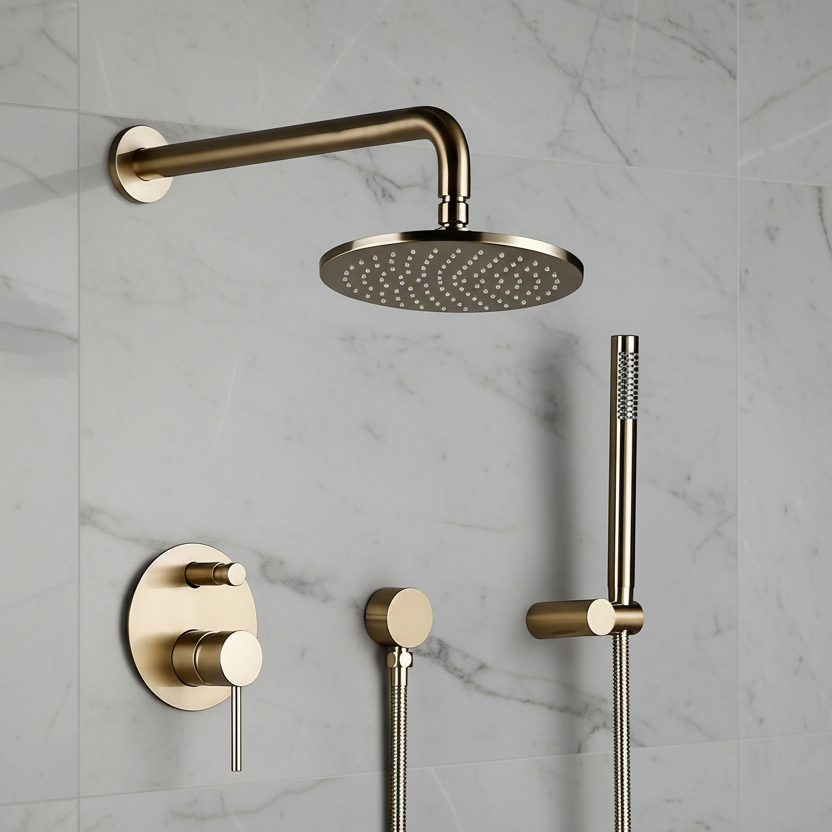
You installed the wide rainfall head you'd been dreaming about — and the "rain" arrived as a gentle drizzle. Weak flow is the number-one complaint with rain showers, and in most homes it's fixable without a plumber. Here's the diagnostic path, from the two-minute checks to the upgrades that genuinely change the experience.
Why Rain Showers Feel Weaker
It's physics before it's plumbing. A standard showerhead pushes water through a small face at speed; a 10- or 12-inch rainfall head spreads the same legally capped flow — typically 1.8 to 2.5 GPM — across four times the area, relying on gravity rather than velocity. Same water, gentler delivery. That's the intended spa effect, but when household pressure is marginal to begin with, "gentle" collapses into "weak."
Start With the Two-Minute Checks
Shut-off valves: confirm the shower's supply stops (and the home's main) are fully open — partially closed valves after any past repair are a classic culprit.
The handheld diverter: if your system has a rain head plus handheld, a diverter set halfway splits flow to both outlets. Set it fully to one side and retest.
Other fixtures: if every faucet in the house runs soft, the issue is house pressure (see below), not the shower.
Descale the Head — the #1 Fix
Mineral scale gradually plugs a rain head's dozens of nozzles, and because flow fades slowly, most people don't notice until half the face is blocked. Unscrew the head and soak it face-down in white vinegar for a few hours, rub the silicone nozzles with a fingertip to break residue loose, rinse, and reinstall. In hard-water areas this single ritual, done a few times a year, keeps a rain shower performing like new. (Full walkthrough: how to clean your shower head.)
House Pressure: The Real Number
A $10 gauge on an outdoor spigot tells you the truth in thirty seconds. Healthy household pressure is 45–80 PSI. Below 40, no showerhead can perform; the fix is upstream — a failing pressure regulator (they age out at 10–15 years), a clogged whole-house filter, or municipal supply issues. Above 80 requires a regulator for the safety of every fixture in the house.
When It's the Shower System Itself
Older two-handle setups and undersized mixing valves choke flow before it ever reaches the head. Modern shower systems are engineered as a matched set — valve, riser, and head sized together — which is why a full-system upgrade so often transforms pressure where a head-swap didn't. If you're choosing a new system, the valve decision matters as much as the head: our thermostatic vs pressure balance guide covers it, and the rainfall shower head guide helps size the head to your pressure reality.
Frequently Asked Questions
Will a bigger rain head give me more water?
No — flow is capped at the same GPM regardless of head size. Bigger heads spread that flow wider and softer. If you love drench pressure, a 8–10 inch head concentrates the experience better than a 12-inch.
Do high-pressure rain showerheads exist?
Heads marketed as high-pressure use smaller nozzles and air-infusion to raise perceived intensity within the legal flow cap. They help at marginal pressure; they can't overcome genuinely low house PSI.
Can a shower pump fix low pressure?
Booster pumps exist for chronic low-pressure homes, but they're a plumber-installed solution of last resort. Exhaust the checklist above first — the fix is usually far simpler.