When designing a modern bathroom, the intersection of luxury and safety creates a delicate equilibrium that demands meticulous attention. Thermostatic shower systems represent a paradigm shift in bathing technology, offering sophisticated temperature regulation that transcends mere convenience. For homeowners, designers, and contractors prioritizing both aesthetic refinement and occupant protection, understanding the nuanced safety mechanisms embedded within these fixtures becomes paramount.
The convergence of precision engineering and residential wellness has elevated thermostatic shower technology beyond conventional mixing valves. These systems employ intricate thermostatic cartridges that respond instantaneously to fluctuations in water supply, maintaining preset temperatures with remarkable consistency. This article examines the critical safety features that distinguish premium thermostatic shower installations from standard fixtures, providing technical insights for those committed to design-led outcomes without compromising household security.
The Fundamental Architecture of Thermostatic Regulation
At the core of every thermostatic shower system lies a wax-filled or bimetallic element that expands and contracts in response to thermal variations. This responsive mechanism automatically adjusts the ratio of hot to cold water, counteracting pressure differentials that occur when toilets flush, dishwashers activate, or washing machines draw water elsewhere in the plumbing network. Unlike traditional pressure-balancing valves that simply equalize flow rates, thermostatic cartridges maintain absolute temperature stability within a narrow band—typically within one degree Fahrenheit of the selected setting.
The internal cartridge houses multiple chambers where incoming hot and cold water streams converge. Thermostatic elements positioned within these chambers detect minute temperature deviations and mechanically adjust aperture sizes to compensate. This happens without electrical components, making these systems inherently reliable even during power outages. The brass construction of premium cartridges ensures longevity and corrosion resistance, critical factors for maintaining consistent performance across years of daily operation.
Anti-Scald Technology: The Primary Guardian
Scalding injuries represent a significant hazard in residential settings, particularly for vulnerable populations including children, elderly individuals, and those with compromised mobility. Anti-scald mechanisms constitute the most essential safety feature in thermostatic shower systems, functioning as a thermal failsafe that prevents water temperature from exceeding dangerous thresholds.
Maximum Temperature Limiters
Premium thermostatic valves incorporate adjustable maximum temperature stops—physical barriers that prevent the temperature control handle from rotating beyond a predetermined point. These limiters are typically factory-set to 100°F or 104°F but can be field-adjusted by installers to accommodate specific household requirements. The mechanical stop engages before the thermostatic element itself reaches dangerous temperatures, creating a redundant layer of protection. This feature proves invaluable in households with young children who might inadvertently manipulate shower controls.
Automatic Cold-Water Cutoff
Should the cold water supply fail unexpectedly due to maintenance, plumbing issues, or supply interruptions, a conventional mixer would discharge scalding hot water directly. Thermostatic systems equipped with cold-water cutoff functionality immediately cease all water flow when cold supply is lost. The thermostatic element detects the absence of cold water and mechanically closes the valve completely, preventing potential burn injuries. This fail-safe mechanism activates within milliseconds, offering protection before users can react to temperature changes.
Exemplary Safety Integration: The WASSER™ Brushed Gold System
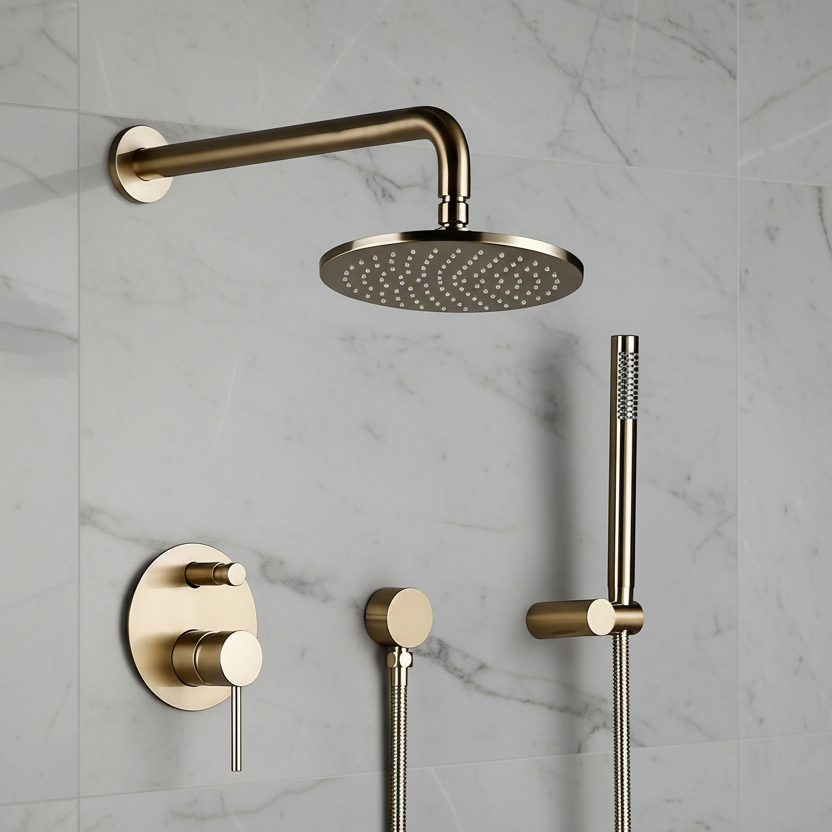
The WASSER™ Brushed Gold Thermostatic Shower System exemplifies how premium manufacturing integrates comprehensive safety protocols without sacrificing aesthetic appeal. This solid-brass fixture combines precision German thermostatic technology with a sophisticated brushed gold finish that complements contemporary and transitional bathroom designs.
The system's thermostatic valve maintains water temperature within ±1.8°F of the selected setting, incorporating both maximum temperature limiting and automatic shut-off when cold water supply drops. The anti-scald mechanism engages at 100°F by default, though contractors can adjust this threshold during installation to align with local building codes or client preferences. The valve's high-flow capacity—supporting simultaneous operation of the rainfall showerhead, handheld wand, and body jets—demonstrates that robust safety features need not compromise performance.
Beyond thermal protection, the WASSER™ system features ceramic disc cartridge technology in all diverter valves, ensuring drip-free operation that prevents unexpected temperature surges caused by worn seals. The substantial brass construction provides thermal mass that dampens rapid temperature fluctuations, adding another layer of stability to the thermostatic regulation.
Pressure Balancing Versus Thermostatic Control
Understanding the distinction between pressure-balancing and thermostatic technologies clarifies why the latter offers superior safety characteristics. Pressure-balancing valves respond to changes in water pressure, adjusting the volume of hot and cold water to maintain proportional mixing. While effective against sudden pressure drops, these systems cannot compensate for temperature variations in the water heater itself.
Thermostatic valves, conversely, monitor actual water temperature rather than pressure ratios. If your water heater malfunctions and begins delivering excessively hot water, a pressure-balancing valve would maintain the same mixing ratio—resulting in dangerously hot shower water. A thermostatic system would detect the elevated temperature and immediately reduce hot water flow while increasing cold water, maintaining your preset temperature regardless of supply conditions.
Check Valves and Backflow Prevention
Integral check valves within thermostatic shower bodies prevent backflow—the reversal of water direction that can contaminate potable water supplies. When pressure differentials occur between hot and cold lines, water from the higher-pressure side can migrate into the lower-pressure supply. Check valves automatically close when reverse flow is detected, maintaining plumbing system integrity.
This feature carries particular significance in installations with multiple fixtures operating simultaneously. Without proper backflow prevention, stagnant water from unused pipes could introduce sediment, bacteria, or chemical contaminants into the shower stream. Premium thermostatic systems incorporate spring-loaded check valves on both hot and cold inlets, meeting ASSE 1016 standards for individual pressure-balancing devices.
Volume Control Independence
Superior thermostatic systems separate temperature adjustment from volume control, a design philosophy that enhances both safety and user experience. Independent control mechanisms allow users to preset their preferred temperature once, then activate and deactivate water flow without disturbing the thermal setting. This architecture eliminates the common safety hazard of accidentally adjusting temperature when reaching for the on/off control.
The separation also facilitates more intuitive operation. Users can turn on the shower, allowing water to reach the preset temperature before stepping under the spray—without the need to modulate controls while exposed to the water stream. For individuals with limited dexterity or visual impairments, this straightforward operational logic reduces the risk of accidental scalding.
Material Specifications and Thermal Stability
The metallurgical composition of thermostatic components directly influences safety performance. Solid-brass construction offers several advantages over zinc alloy or plastic alternatives that extend beyond mere durability:
- Brass provides superior thermal conductivity, allowing the thermostatic element to sense temperature changes more rapidly
- The material's corrosion resistance prevents internal degradation that could compromise valve sealing surfaces
- Brass maintains dimensional stability across temperature extremes, ensuring consistent mechanical tolerances
- The material's thermal mass dampens rapid temperature spikes, creating smoother regulation
Premium thermostatic cartridges utilize brass bodies with specialized elastomer seals rated for continuous exposure to temperatures up to 180°F. These seals maintain their flexibility and sealing integrity far longer than standard rubber components, preventing the gradual performance degradation that can introduce safety vulnerabilities over time.
Compliance With Safety Standards
Reputable thermostatic shower systems undergo rigorous testing to verify compliance with established safety protocols. Understanding these certifications helps specifiers ensure their selections meet or exceed regulatory requirements:
| Standard | Jurisdiction | Primary Focus |
|---|---|---|
| ASSE 1016 | North America | Automatic compensating valves for individual fixture installations |
| CSA B125 | Canada | Plumbing fittings and fixtures performance requirements |
| IAPMO/cUPC | United States | Uniform Plumbing Code compliance for installation nationwide |
| EN 1111/EN 1287 | European Union | Thermostatic mixing valve specifications and testing protocols |
These certifications verify that thermostatic valves maintain temperature stability under various supply conditions, incorporate proper backflow prevention, and include fail-safe mechanisms for supply interruptions. When evaluating fixtures, confirming these compliance markers ensures the system has undergone independent verification of its safety claims.
Installation Considerations for Optimal Safety
Even the most sophisticated thermostatic system requires proper installation to deliver its full safety potential. Several critical factors influence performance:
Supply Line Balance
Thermostatic valves function optimally when hot and cold supply pressures remain relatively balanced. Significant pressure differentials—typically exceeding 15 psi—can overwhelm the thermostatic element's compensatory capacity. Installing pressure-reducing valves on the higher-pressure line or pressure-boosting pumps on the lower-pressure side creates the equilibrium necessary for precise regulation.
Sediment Filtration
Particulate matter in water supplies can accumulate within thermostatic cartridges, interfering with the precise mechanical movements required for temperature maintenance. Installing inline sediment filters on both hot and cold supply lines protects internal components from debris. This preventive measure extends cartridge lifespan while ensuring consistent safety performance.
Thermal Expansion Accommodation
Thermostatic valves installed in closed plumbing systems—those with backflow preventers or check valves at the water meter—require thermal expansion tanks. Without accommodation for expanding heated water, pressure surges can affect thermostatic regulation accuracy and potentially compromise sealing surfaces over time.
Maintenance Protocols for Sustained Protection
Thermostatic safety features maintain their protective capabilities only through appropriate maintenance schedules. Regular inspection and servicing ensure that protective mechanisms remain responsive and reliable.
Quarterly testing of the maximum temperature limiter verifies that the safety stop remains properly calibrated. Simply measuring the maximum water temperature achievable confirms the limiter functions correctly.
Annual cartridge inspection allows contractors to identify early signs of mineral accumulation or seal deterioration before they compromise performance. In areas with hard water, descaling treatments every six months prevent calcium buildup that can impede the thermostatic element's mechanical response. Replacing cartridge seals every three to five years—depending on water quality and usage frequency—maintains the tight tolerances necessary for precise temperature control.
Addressing Common Safety Questions
Can Thermostatic Systems Prevent Legionella Growth?
While thermostatic valves excel at preventing scalding, they require thoughtful integration with water heater settings to address Legionella concerns. These bacteria proliferate in water maintained between 77°F and 113°F. Setting water heaters to 140°F eliminates Legionella at the source, while thermostatic mixing valves then reduce delivery temperature to safe levels at fixtures. This layered approach addresses both microbial and thermal safety.
Do Electronic Thermostatic Systems Offer Enhanced Safety?
Electronic thermostatic valves incorporate digital temperature sensors and motorized mixing mechanisms, offering precise control and programmability. However, their reliance on electrical power introduces vulnerability during outages unless equipped with battery backup systems. Mechanical thermostatic valves, conversely, function independently of power supplies, maintaining protection under all circumstances. For critical safety applications, mechanical systems often prove more universally reliable.
How Quickly Do Thermostatic Valves Respond to Temperature Changes?
Premium thermostatic cartridges typically respond to temperature deviations within one to two seconds, adjusting water mixing ratios before users perceive significant changes. This rapid response time contrasts sharply with manual mixing valves, where users must consciously detect temperature variations and manually compensate—a process that can take several seconds during which exposure to unsafe temperatures continues.
The Long-Term Value Proposition
Initial investment in thermostatic shower systems exceeds that of conventional fixtures, yet the long-term value calculus extends beyond monetary considerations. The elimination of scalding incidents protects household members from injuries that carry both human and financial costs. Insurance implications, potential liability exposures, and medical expenses associated with thermal injuries dwarf the incremental cost of thermostatic technology.
For designers and contractors, specifying thermostatic systems demonstrates professional diligence and commitment to occupant welfare—attributes that enhance reputation and client satisfaction. The technical specifications, durable brass construction, and comprehensive safety integration align with the expectations of discerning clients who prioritize both performance longevity and risk mitigation.
Future Considerations in Thermostatic Safety
Emerging technologies continue advancing thermostatic shower safety. Smart integration allows remote temperature monitoring and adjustment, with some systems sending alerts when anomalies occur. Predictive maintenance algorithms analyze usage patterns to anticipate cartridge wear before failures occur. Voice-activated controls eliminate the need for manual manipulation, particularly beneficial for individuals with mobility limitations.
Despite these innovations, the fundamental mechanical thermostatic valve remains the cornerstone of shower safety. Its independence from digital systems, electrical supplies, and network connectivity ensures universal reliability across diverse installation contexts and usage scenarios.
The selection of thermostatic shower systems represents an investment in occupant protection that transcends stylistic considerations. By understanding the sophisticated safety mechanisms embedded within premium fixtures—from anti-scald limiters to automatic shutoff valves—homeowners, designers, and contractors can make informed decisions that balance aesthetic aspirations with fundamental responsibility for user welfare. The technical specifications, material quality, and safety certifications distinguish fixtures that merely meet minimum requirements from those that establish new standards for residential bathing security.
Still deciding between valve technologies? Read our head-to-head comparison: Thermostatic vs Pressure Balance Shower Valves: Which to Choose.