Antique brass is having a moment that shows no sign of ending — and unlike most finish trends, this one is built on something real. It's the only common bathroom finish that improves with age rather than merely surviving it. The warm, slightly weathered tone bridges traditional and modern in a way chrome never manages, and it hides fingerprints and water spots better than almost anything else you can put in a bathroom.
This guide covers what antique brass actually is, how it differs from the lookalikes it gets confused with, where it works best, how to care for it, and how to combine it with other metals without the room reading like an accident.
What Antique Brass Actually Is
Antique brass starts as solid brass — a copper-zinc alloy — that is chemically darkened and then relieved, so the recesses stay dark while raised surfaces catch the light. The result is depth: a fixture that reads warm gold in bright light and deep bronze in shadow. That variation is the entire appeal, and it's why photographs never quite do the finish justice.
There are two families worth distinguishing. A sealed antique brass holds its appearance indefinitely — what you unbox is what you'll have in ten years. An unlacquered or living finish continues to patina with handling and humidity, deepening over time. Both are legitimate; they simply suit different owners. Most fixtures in our antique brass collection use a sealed finish for predictability.
Antique Brass vs. the Lookalikes
| Finish | Character | Best For |
|---|---|---|
| Antique Brass | Warm, aged, tonal variation | Traditional, farmhouse, transitional, eclectic |
| Brushed Gold | Even satin warmth, no aging | Modern and contemporary spaces |
| Polished Brass | Bright mirror gold, formal | Classic, glamorous, high-contrast rooms |
| Oil-Rubbed Bronze | Darker, browner, less gold | Rustic and Mediterranean styles |
| Champagne Bronze | Light, pinkish-warm, uniform | Soft modern palettes |
The practical difference that matters most: antique brass is tonal, not uniform. If you want every fixture in the room to match precisely, brushed gold is the safer choice — see our comparison of brushed gold vs polished gold. If you want warmth with character, antique brass is the one.
Where Antique Brass Excels
The Shower Question
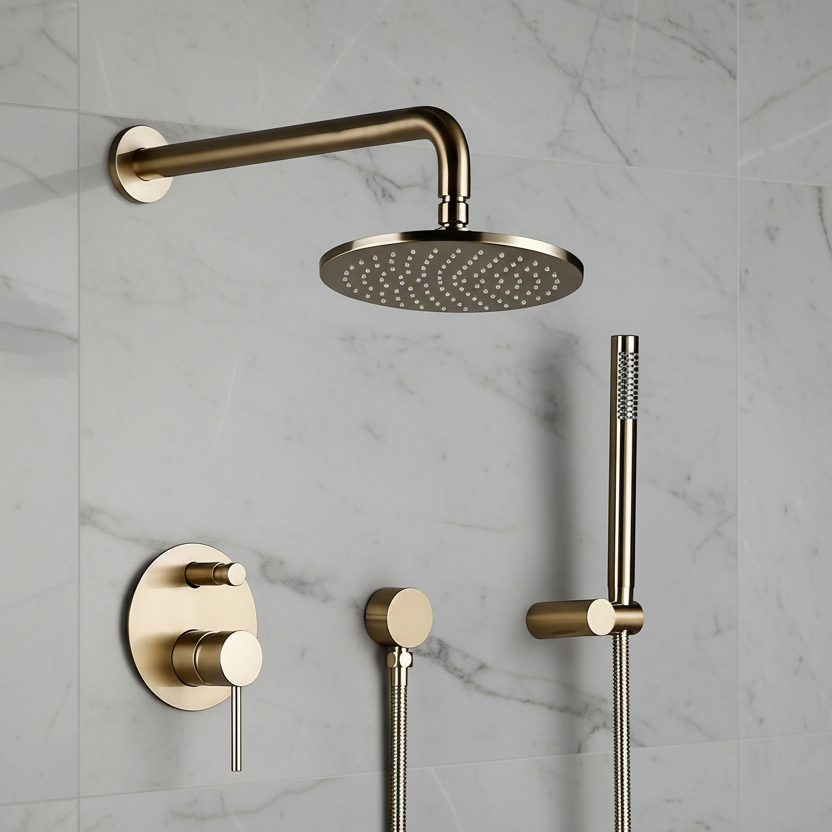
Antique brass shower systems are the fastest-growing corner of the finish, and the reasoning is sound: a shower enclosure is humid, hard-water-prone, and constantly touched — exactly the environment where a forgiving tonal finish outperforms a mirror one. An antique brass shower system with a rainfall head and handheld sprayer delivers the vintage look without the vintage maintenance burden, provided the valve body underneath is solid brass with a ceramic cartridge.
Living With It: Care and Patina
Care is refreshingly simple. Wipe with a soft damp cloth and dry it — that's the routine. Avoid abrasive pads, ammonia, bleach, and acidic cleaners, all of which strip or blotch the finish. Never use metal polish: polish is designed to remove oxidation, which is precisely the character you paid for.
If you have a living (unlacquered) finish and want to slow the patina, dry the fixture after each use and keep the room ventilated. If you want to encourage it, simply use the bathroom normally — hands, humidity, and time do the work.
Mixing Antique Brass With Other Metals
Antique brass mixes more forgivingly than any other warm finish because its tonal variation already contains several colors. The reliable pairings:
The governing rule is the one from our mixing metal finishes guide: keep all water-carrying plumbing in one finish, and let the second metal live in hardware and lighting.
Frequently Asked Questions
Does antique brass go out of style?
It has less trend risk than most finishes because it isn't a trend in the usual sense — it's a heritage finish that periodically returns to prominence. Chrome and antique brass are the two finishes least likely to date a bathroom.
Will antique brass fixtures match each other exactly?
Close, but not identically — tonal variation is inherent to the finish, and pieces from different production runs can differ slightly. Buying a complete matched system rather than assembling pieces separately avoids most of this.
Is antique brass hard to keep clean?
The opposite. It's among the most forgiving finishes available, hiding water spots and fingerprints that chrome and polished gold display constantly. Soap, water, and drying is the entire routine.
Can I use antique brass in a modern bathroom?
Yes, and it's one of the strongest moves in contemporary design — a single warm metal running through a cool, minimal room. Pair it with matte black or gunmetal rather than with other warm golds.
What's the difference between antique brass and bronze?
Antique brass retains a gold undertone; oil-rubbed bronze is browner and darker with little gold. Under warm bathroom lighting the difference is obvious side by side, less so in photographs.
Still deciding between warm finishes? See Antique Brass vs Oil-Rubbed Bronze.